Crypto markets enter the second half of 2026 amid the most drawn-out correction since 2022. Digital assets have now posted three consecutive quarters of losses, the longest losing streak since the last cycle's bear market, as institutional capital has rotated out of digital assets and into AI adjacent equities, and Bitcoin ETFs have recorded their largest quarterly outflow since launch. Bitcoin itself is trading in the mid $60,000s, well-off cycle highs, and sentiment across the crypto industry has swung from euphoria to uniform bearishness. This report is less about calling a bottom in any single asset and more about where the money travels once this range is resolved, because that is where Jones Digital Capital Fund 2 will thrive.
Own Your Bitcoin. Invest In the Rest.
The cornerstone of how I run this fund is a low allocation to Bitcoin, generally in the sub 10 to 15 percent range of the book. That is deliberate. I believe every investor in this fund should already hold their own Bitcoin, bought and custodied directly, the same way you would hold gold or cash. Bitcoin does not need my help. Where the true value lies are everything sitting on top of it, the hundreds of protocols, chains, and tokens that require real technical diligence, security practice, and constant monitoring to hold safely and size correctly. This is the knowledge and security that an investment in the fund unlocks. I'm not being paid to hold Bitcoin for you, I'm being paid to safely and profitably position capital in the parts of this asset class that are prohibitively difficult to access as a non-digital native.
Fund 1 is the proof of that approach. Operating long only, with no hedges and no shorts, through the Terra and FTX collapses and back out the other side, Fund 1 returned 31.66 percent to investors over its four-year life while the ETH benchmark fell 35.75 percent over the same stretch, a cumulative outperformance of 67.42 percent and an annualized alpha of 17.25 percent against that benchmark. Very little of that outperformance came from being right about Bitcoin's price. It came from active selection further out on the risk curve, which is exactly where I expect the next leg of this cycle to be won.
The Waterfall
Crypto capital moves in a fairly consistent pattern once a cycle turns, and I think of it as a waterfall. Money enters through Bitcoin first, because it is the most liquid, the most understood, and the easiest for a new allocator to underwrite. From there it spills into Ethereum, then into the large cap alternative layer ones, and only once both of those legs are underway does it reach the smaller, higher beta parts of the market where the largest multiples on capital actually get made. Every cycle rhymes with this pattern, and every cycle it catches investors who assume Bitcoin alone captures the opportunity.
Solana is the clean recent example. SOL fell to roughly $8 in the depths of the 2022 bear market and traded above $295 at its January 2025 high, a move of more than 30 times that dwarfs anything Bitcoin did over the same stretch. Hyperliquid is an even sharper illustration precisely because it did not exist for most of the last cycle. HYPE launched in November 2024 under $8 and reached an all time high near $77 within about eighteen months, becoming one of the largest tokens in the market from a standing start. An investor holding only Bitcoin through that period captured a real but comparatively modest return. An investor positioned in the right names further down the waterfall captured a multiple of it. That gap, not a directional call on Bitcoin, is the return stream this fund exists to capture.
The Concentration Trade
Traditional risk markets are offering an instructive preview of how narrow real leadership can be, and why picking correctly inside a narrow field is worth paying for. The S&P 500's roughly 8 percent gain over the trailing six months has been driven almost entirely by a small handful of semiconductor and hardware names. Micron has contributed close to 1.4 percentage points of that gain on its own, the single largest contribution of any index constituent, after rallying approximately 188 percent. AMD has added close to 0.9 points after surging around 158 percent, while Apple and Intel have each contributed roughly 0.8 points on gains of about 20 percent and 205 percent, respectively. Broadcom, Nvidia, and Sandisk round out the list with contributions near 0.4 points apiece. Owning the index got you 8 percent. Owning the right six names got you multiples of that.
I expect the same dynamic in crypto, and the waterfall illustrates exactly why. The next leg's returns will not be distributed evenly across Bitcoin, Ethereum, Solana, Hyperliquid, and whatever comes after them. They will concentrate hard in whichever of those, or whichever newer name, captures tomorrow's narratives of real-world assets, decentralized physical infrastructure networks, and AI. Identifying that in real time, and sizing it correctly relative to the more liquid, easier to hold pieces of the portfolio, is the actual job this fund is built to do.
Majors Reclaim the Wheel
That rotation is already showing up in its earliest stage. Early sentiment looks like cash heavy, traditional finance buyers stepping in to acquire coins at year-to-date discounts. Crypto media over-indexes on the four-year cycle framework and had broadly positioned for a bottom in Q4, so I suspect smart money instead saw a genuine discount, fear around Strategy's balance sheet (more below), and AI name strength pulling capital elsewhere, and used it to accumulate ahead of the crowd.
Q3 is going to be the tell. If price action stays constructive, I expect sideline capital to chase the move, and I would point to on chain activity, already showing early signs of life, as a leading indicator. Institutions have also started to speak more openly about crypto and real world assets, Robinhood is a good example, and that public bullishness both encourages sidelined capital to allocate and forces crypto native teams to sharpen execution to compete for it. This is stage one of the waterfall. Stage two, further out the curve, is where this fund is built to perform.
Echoes of Late 2023
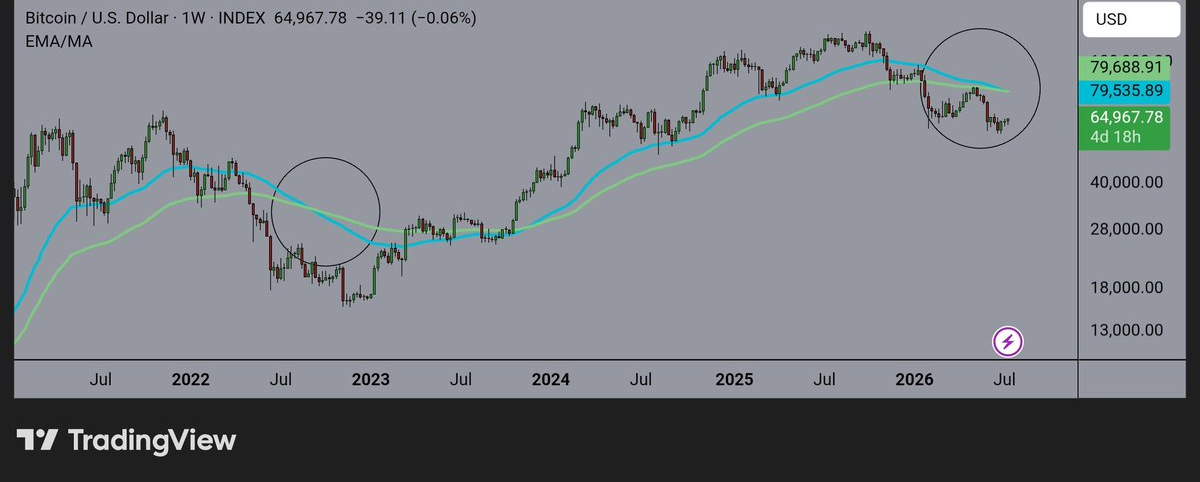
Bitcoin's weekly chart currently rhymes with the basing pattern that preceded the last cycle's bottom in late 2023, a similar compression around the moving averages after a sharp drawdown, followed by a grind sideways rather than a continued collapse. I do not think we are finished chopping. Whatever the next leg down looks like, I expect it to be a buying opportunity rather than a reason to de-risk further. That is not a call to lever up into every dip, but the entries available over the next three to six months should look, in hindsight, like exceptional value relative to where I expect majors, and the right alts sitting behind them, to trade by the back half of 2027.
The Fastest Horse
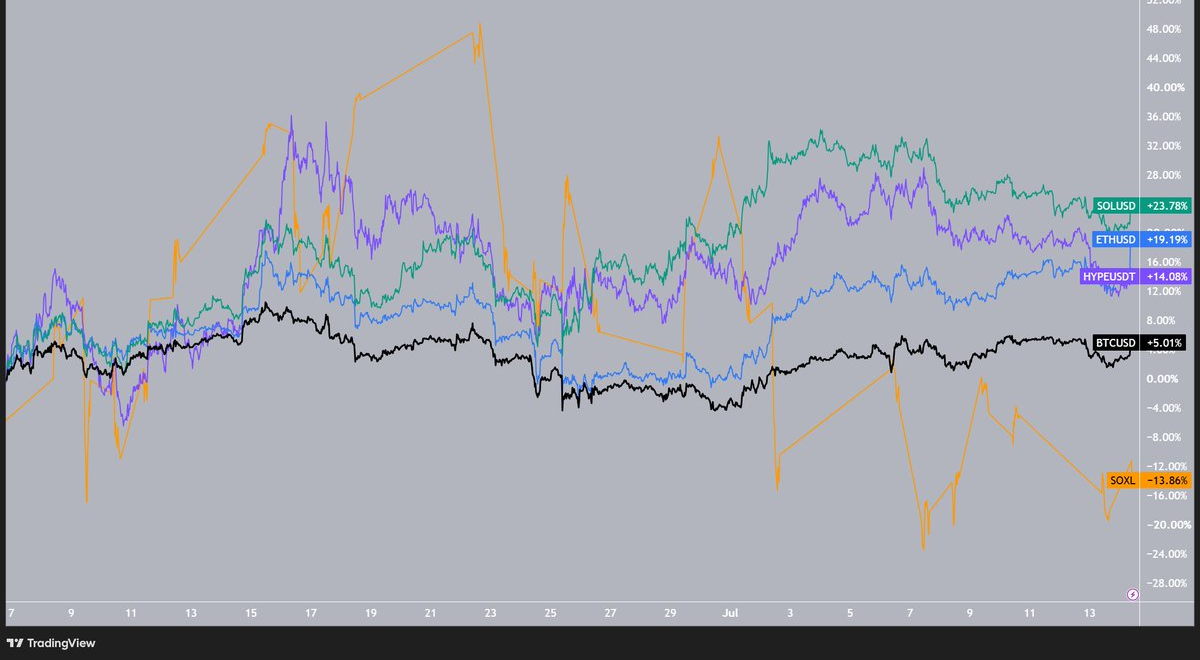
One underappreciated tell for crypto's next leg is its performance relative to the trade that has soaked up risk appetite for the past year, semiconductors. Over the trailing several weeks, Solana, Ethereum, and Hyperliquid have all meaningfully outperformed even a 3x leveraged semiconductor ETF, while Bitcoin has held a modest positive return against a leveraged semiconductor position now down double digits. Notice which lines are doing the outperforming. It is not Bitcoin. Crypto tends to outperform when it is the fastest horse in the risk on race, and right now the fastest parts of crypto are already the alts, not the benchmark.
The Saylor Flywheel
No discussion of crypto's setup into year end is complete without addressing Strategy (formerly MicroStrategy, ticker MSTR), because I think its unwind is one of the more likely catalysts for a durable bottom across the space, not just in Bitcoin. Strategy's model has always worked as a flywheel. Raise capital cheaply against a rising Bitcoin price, through common equity issued near or above net asset value or through its stack of preferred instruments, STRK, STRF, STRC, and STRD, then use the proceeds to buy more Bitcoin, which lifts the NAV and makes the next raise easier. STRC in particular was engineered as a high-yield, low-volatility instrument anchored near $100 par, with a variable dividend, recently in the 11-12% annualized range, that adjusts monthly to keep the stock near par. When STRC and the other preferreds trade at or above par, Strategy issues new shares through its at-the-market program and routes the proceeds straight into Bitcoin purchases and dividend coverage, without touching the balance sheet's existing Bitcoin.
The flywheel only spins in one direction, though, and that direction requires Bitcoin to keep climbing, or at minimum for MSTR to keep trading at a premium to its Bitcoin net asset value. Over the past year, that premium has largely evaporated. MSTR shares are down sharply from their highs, STRC has repeatedly traded below its $100 par, and the company's preferred dividend obligations have grown enormously, from roughly $10 million in the first quarter of 2025 to north of $229 million in the first quarter of 2026 alone. When ATM issuance dries up because the stock is not trading at a level that makes new issuance attractive, Strategy has to find cash elsewhere. This July, following a sharp Q2 unrealized loss on its Bitcoin holdings of more than $8 billion, the company did something that would have been unthinkable a year ago. After a small test sale in late May, it sold roughly 3,600 Bitcoin for about $216 million in early July, specifically to fund preferred dividends and replenish its dollar reserve.
Many people in this market believe this is precisely the kind of structural unwind that has to happen before a bear market can bottom. Strategy has been, for several years, the largest and most consistent marginal buyer of Bitcoin, and a persistent source of one directional demand that many holders had come to take for granted. A forced, mechanical deleveraging of that position removes a source of latent selling risk hanging over the market rather than adding new demand back into it. Historically, capitulation events that clear out the most levered, most fragile hands in a market precede a bottom rather than further downside, and I think Strategy's flywheel unwind is playing that role for this cycle. The company still holds roughly 844,000 Bitcoin, so this is not a solvency event, but the overhang of a largest corporate holder possibly being a forced seller has been a real drag on sentiment across the whole space, and I expect that drag to lift as the deleveraging plays out over the coming months.
Scarcity, Priced Correctly
I want to be precise about the macro backdrop, because the easy version of this narrative overstates where things stand. The Strait of Hormuz situation has not resolved. After a mid June ceasefire briefly reopened the waterway, the U.S. reinstated its naval blockade on Iran this week, and attacks on shipping have continued, so the geopolitical risk premium in energy markets is still live rather than fading. That matters for the Fed side of this too. War driven inflation pushed May's CPI print to its highest annual rate in three years, and the Fed's June meeting under new Chair Kevin Warsh actually leaned hawkish, stripping easing language from its statement and opening the door to a hike as soon as October rather than the cuts the market had priced in earlier this year. The “rate cuts unlock trillions in liquidity” version of this story is not what is actually on the table right now. If anything, the near term policy backdrop is a headwind rather than a tailwind.
None of that changes my medium term view. Gold has done the heavy lifting as the preferred hedge this year while Bitcoin lagged, which is itself informative. It tells me about the rotation into scarce assets that Paul Tudor Jones and others describe is real, it is just landing in the older, more established store of value first. That rotation has historically broadened out over time, with Bitcoin closing the gap once the acute phase of a macro shock passes, and with the alts behind Bitcoin closing their own gap once Bitcoin's does. Combined with the Strategy deleveraging described above, which I read as digesting the worst of the forced selling overhang rather than compounding it, I think the setup into Q4 still favors patience over panic, even if the next month or two of headlines stays noisy.
The October Setup
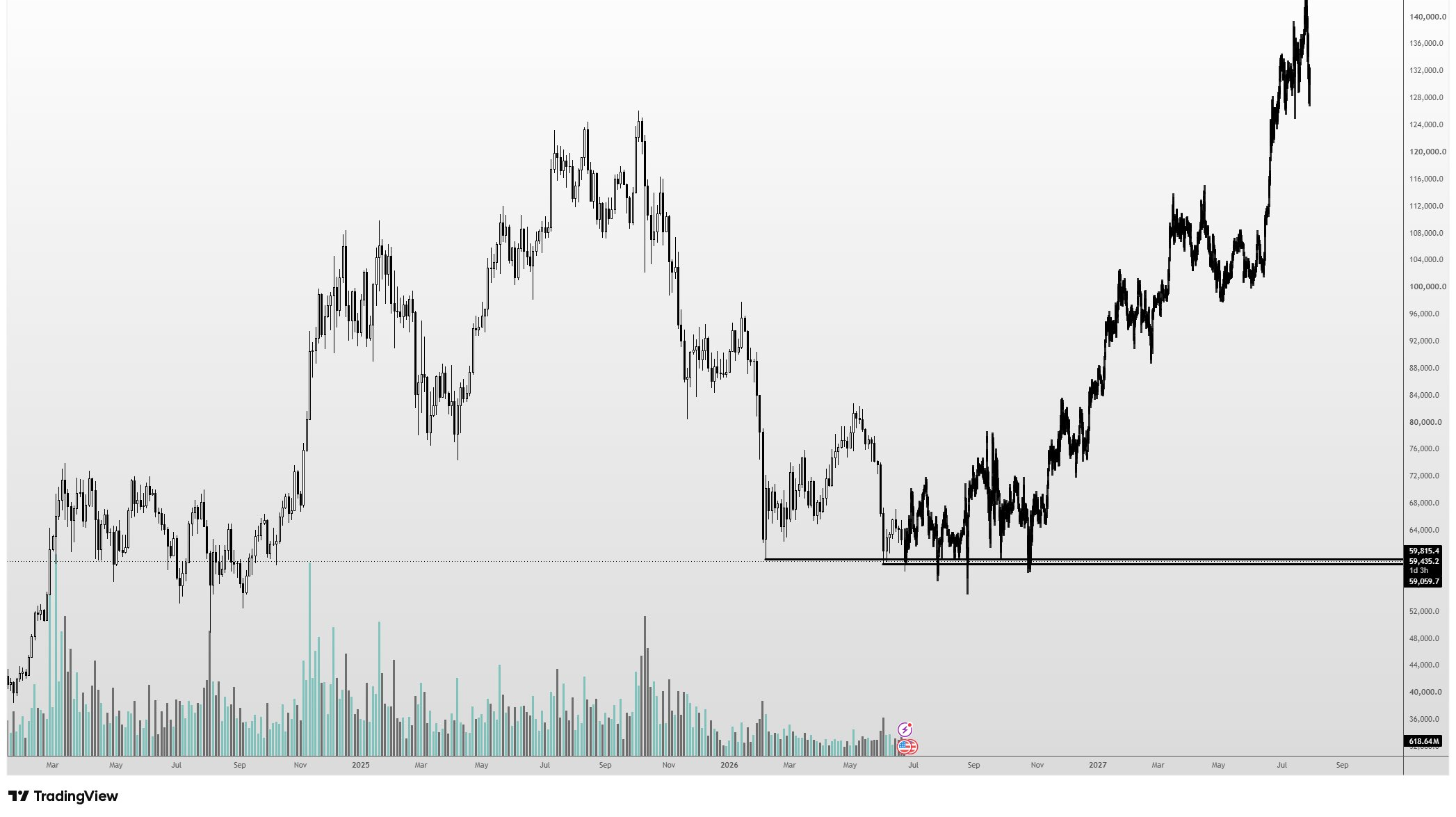
Zooming out reinforces the cycle bottom timing I have been describing above. Since topping near $124,000 in the back half of 2024, Bitcoin has spent roughly a year and a half carving out a wide range broadly bounded by the high $50,000s to mid $60,000s, a compression that, in both duration and character, closely resembles the multi-quarter base that preceded the last cycle's breakout. My base case is that this range resolves to the upside around October, consistent with the post-halving cadence many crypto natives are positioned for, and that a confirmed break above the range highs opens the door to a continuation toward new all-time highs into 2027. I want to be careful about false precision on a single month, but the technical structure, current positioning, and historical cycle timing are all pointing the same direction. Bitcoin resolving higher is the signal I am watching for, not the position I am sizing hardest into.
Last Cycle's Trade, This Cycle's Trade
Every cycle has a narrative that captures a disproportionate share of the capital moving down the waterfall. Last cycle, that narrative was Hyperliquid and the broader perpetual DEX complex, alongside liquid staking and restaking. Positioning early in that theme is a meaningful part of how Fund 1 generated its outperformance against the ETH benchmark, and it is a clean example of the kind of call this fund is built to make.
This cycle, my attention is on two themes I think carry the largest source of upside, real world asset adoption and the convergence of AI and crypto. Tokenized treasuries, credit, and equities are moving from pilot programs into institutional scale infrastructure, stablecoin transaction volumes have already surpassed those of Visa and Mastercard individually, and regulatory frameworks in both the US and EU are formalizing the rails that make tokenized traditional assets usable at scale. That combination, real yield bearing collateral, real regulatory clarity, and real institutional balance sheets looking for on chain settlement, is a different kind of catalyst than a purely speculative narrative.
The second theme is the intersection of AI and crypto. Decentralized compute networks, AI agent economies, and on chain model verification are creating an entirely new category of digital asset investment, and it is one of the fastest growing thematic opportunities in technology right now. On chain research gives this fund a genuine edge here, the same kind of edge that let us identify Hyperliquid and the perpetual DEX complex early last cycle, and I think it applies just as well to finding the protocols that end up sitting at the center of AI native, on chain economies.
I expect both RWA adoption and AI crypto convergence to follow the same waterfall dynamic as every narrative before them. Early positioning in the protocols and chains that become the default infrastructure for either theme is where the disproportionate returns will show up, the same way early Hyperliquid or Solana exposure did last cycle. Finding that positioning before it is obvious is, again, the actual job.
Conclusion
I remain constructive on digital assets into the back quarter of 2026, though less because of a single price target on Bitcoin and more because of where I expect capital to travel once this range resolves. My own book stays disciplined at a low, sub 15 percent Bitcoin weighting by design. I want every investor holding Bitcoin directly and independently, and I want this fund earning its fee by being early and correctly sized in Ethereum, the majors catching Solana's momentum, and the RWA and AI infrastructure I expect to define this cycle's biggest winners, the way Fund 1 did with Hyperliquid and the perpetual DEX complex last time, a track record detailed in full at jonesdigitalcapital.com. Strategy's ongoing deleveraging is a catalyst I am watching closely for signs of exhaustion in the corporate treasury overhang, and the pre 2025 range low near $52,000 and the roughly $42,000 ETF era range on Bitcoin are levels I would treat as high conviction points to add to the book broadly, not only in Bitcoin itself. Whatever shape the next leg down takes, I expect it to be a buying opportunity across the curve, and I expect the entries available over the next two to three quarters, in the right assets, to look like some of the best of this cycle.
Please feel free to contact me with any questions on this report or if there is a project you would like to discuss in more detail. I am also happy to discuss any questions you may have regarding investments into Jones Digital Capital at 651-724-0685, or at carter@jonesdigitalcapital.com.