Q3 closed as one of the sharper reversals of this cycle: Bitcoin rallied roughly 40 percent off its July lows, clawing back from a three quarter losing streak that tied the longest in its history, and Ethereum did even better, up close to 70 percent over the same stretch. That rebound has carried into October, but it has carried us into a market that is harder to read than it was three months ago. Bond yields sit at levels not seen in two decades, the Strait of Hormuz + Iran situation remains unresolved, and the country heads into chaotic November 3 midterms with a Fed that just delivered its first rate hike in three years. None of that has stopped Bitcoin and Ethereum from rallying, or Wall Street from turning more constructive. Citi raised its 12-month Bitcoin target from $82,000 to $113,000 this week, citing returning ETF demand and a more supportive macro backdrop, and it isn't the only desk saying it: Standard Chartered reaffirmed its $100,000 year-end target after Bitcoin's 42 percent Q3, and Bernstein is holding at $125,000 for year-end, arguing the traditional four-year cycle has already broken under the weight of institutional buying. The question for Q4 isn't whether the setup is bullish or bearish. It's which of two very different macro paths resolves first, and what that means for the capital waterfall that will follow.
Two Doors
I think about Q4 as two doors, and right now we're standing between them rather than having walked through either.
Door one is more tightening. The Fed hiked 25 basis points on September 16 to a 3.75-4.00 percent target range, its first increase since July 2023, passed unanimously, with inflation still running near 3.4 percent year over year. The 30 year Treasury yield touched 5.44 percent on September 24, its highest level since 2004, before the Treasury stepped in with long bond buybacks that took some of the edge off. If the October 27-28 or December meetings bring another hike, or the Fed simply holds the line into a genuinely inflationary environment, the setup favors Bitcoin specifically over the rest of the market. That's the “digital gold” case implicit in this round of upgrades: a hedge against currency debasement and persistent inflation, priced as cash on steroids rather than as a bet on the broader crypto risk curve. In that world, I'd expect BTC dominance to hold up or rise, and altcoin performance to lag even if Bitcoin itself is constructive.
Door two is that this was the Fed's last hike, or close to it. Inflation prints roll over, the labor market softens further than a 4.1 percent unemployment rate currently suggests it will, and October or December brings a pause the market reads as the top of the cycle. That's the scenario where the waterfall framework from last quarter's letter actually plays out: capital that has been parking in Bitcoin as the easiest, most liquid way to express a “risk assets are fine, inflation is manageable” view starts cascading down into Ethereum, Solana, and the names further out on the curve.
Right now the market is behaving like door two is winning even while we're technically standing in door one. Bitcoin and Ethereum rallied through a rate hike, not in spite of one being priced out, and Citi's own note points to ETF demand and a weaker dollar, not a change in rate expectations, as the driver. I don't think that contradiction resolves cleanly before year-end, and I'd treat it as the single biggest swing factor for Q4 position sizing: own more Bitcoin outright if door one reasserts itself, own more of the waterfall if door two does.
What the Calendar Says (and How Much to Trust It)
Seasonality is a weak prior, not a signal, and I'd rather show the data with that caveat built in than bolt it on at the end.
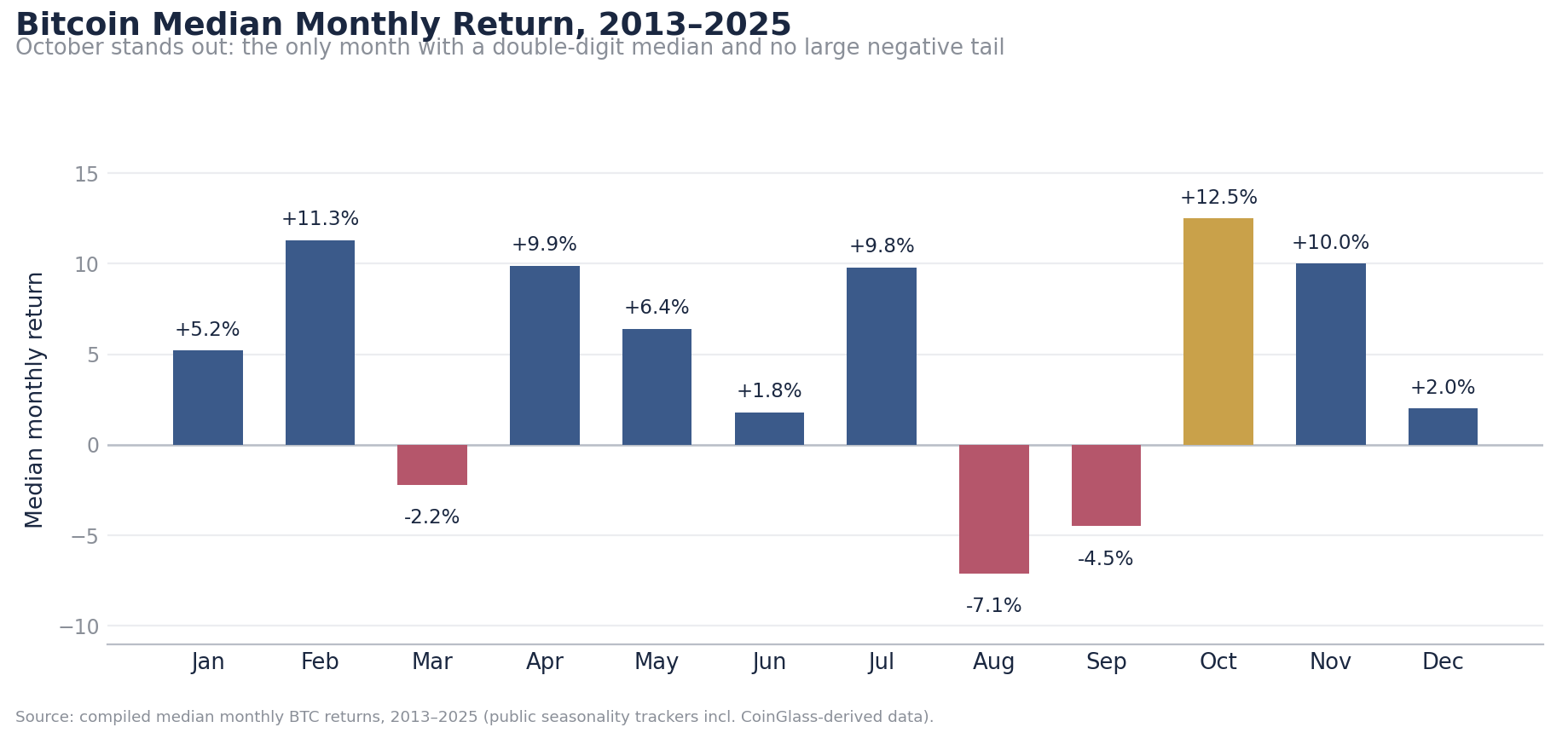
Since 2013, October is the only month with a double-digit median return and no outsized negative tail: a median of +12.5 percent, against Bitcoin's worst month, August, at −7.1 percent. The effect compounds at the quarterly level.
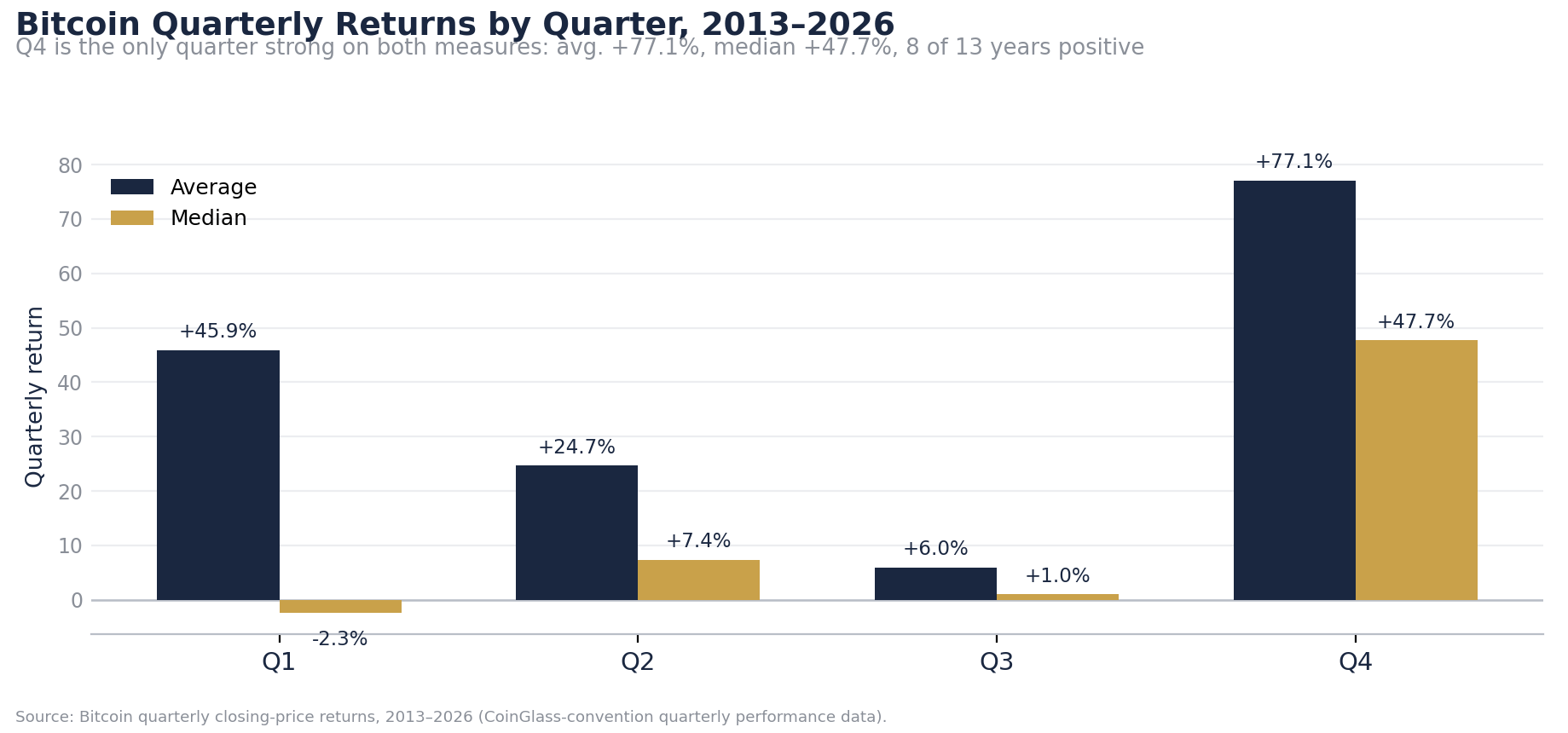
Q4 is the only quarter strong by both measures that matter: a median return of +47.7 percent (the average, at +77.1 percent, is skewed by 2013 and 2017), and eight of the last thirteen Q4s closing positive. The honest caveat, and the one I'd actually underwrite a position on, is that Q4 has failed exactly twice in that sample, 2018 and 2022, and both times it failed because the macro regime was tightening, not because the calendar stopped working. Seasonality rides the regime; it doesn't override it. That's precisely why the “two doors” framing above matters more this quarter than the calendar does.
The Range
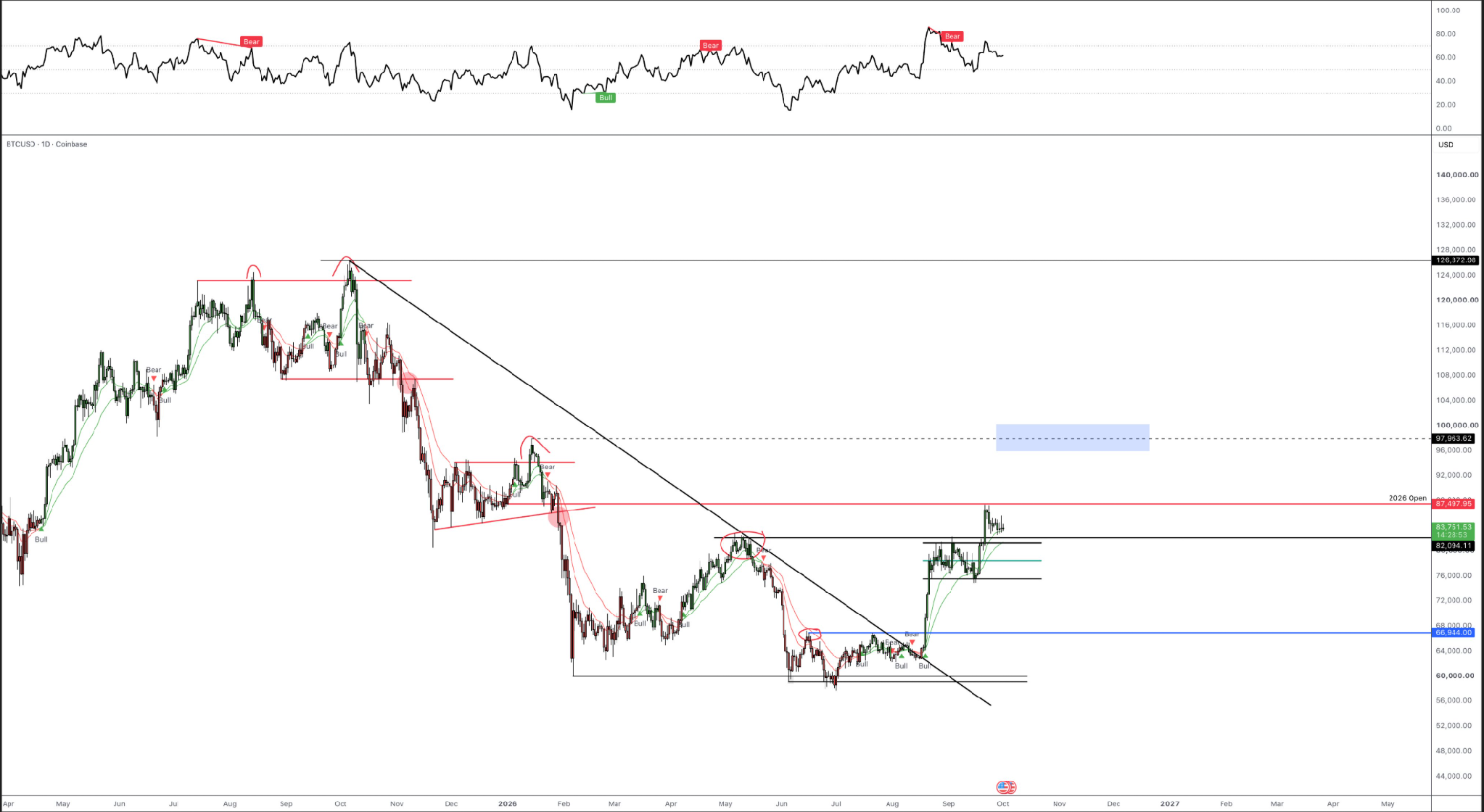
None of that is a reason to force a position right now. Bitcoin has spent the last few weeks consolidating in a tight band roughly between $82,500 and $85,500, and that range has held through enough chop that it's not actionable to force trades in either direction until it resolves. A confirmed break above $85,500 opens the door toward the $97,000-98,000 supply zone that capped BTC earlier this cycle; a confirmed break below $82,500, which lines up closely with the support marked on the chart above, likely means a retest lower before buyers show back up in size. I would rather wait for that resolution than guess at it: this is a range to watch, not a range to trade, and I'd treat any position sized for a breakout before the breakout happens as a bet on the calendar rather than on the market.
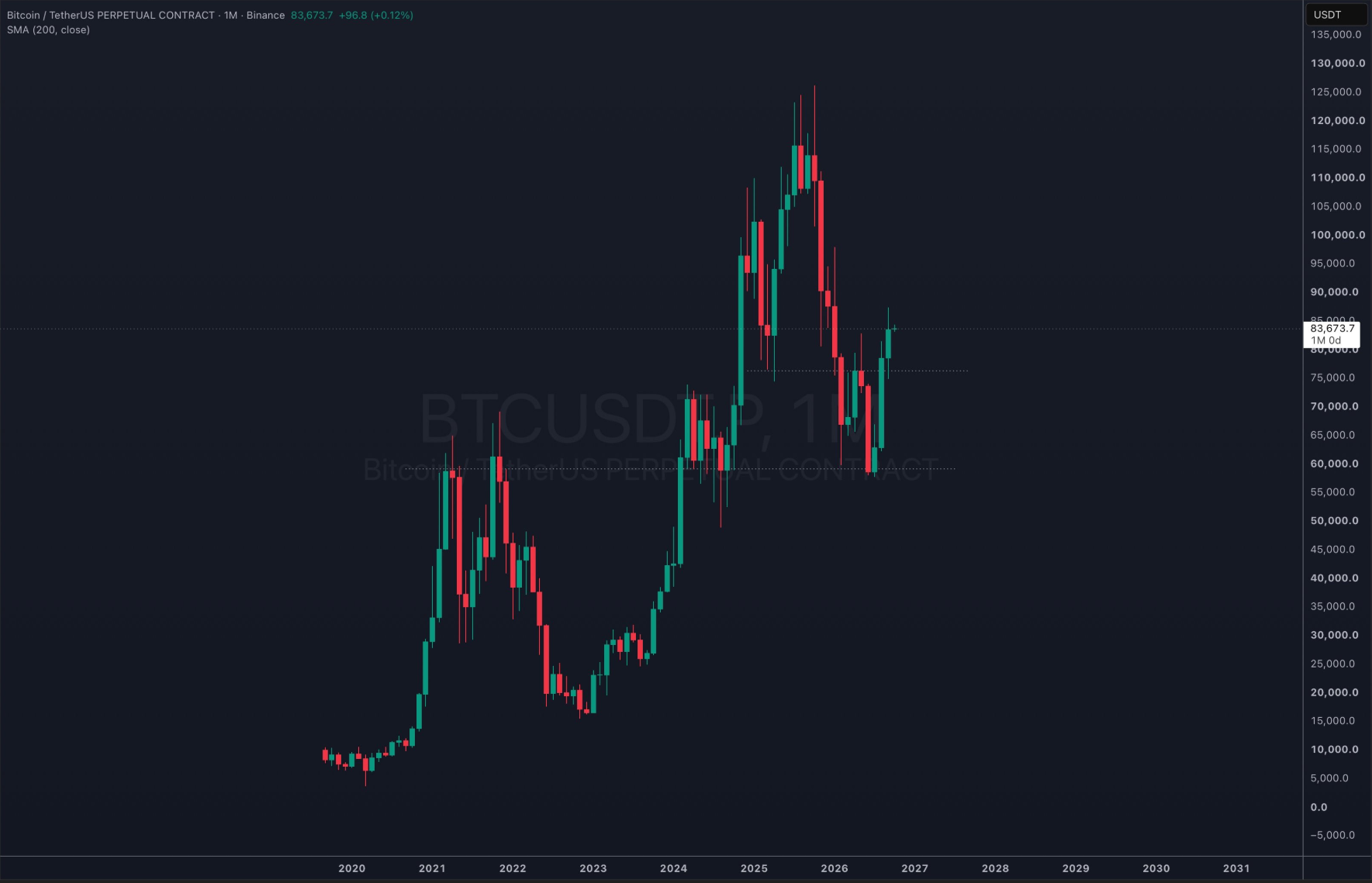
Pulling back to the monthly chart, the current consolidation sits almost exactly where the 2023 base did before that cycle's breakout: a multi month range built on top of a deep correction rather than at the top of one. That doesn't make the breakout direction obvious, but it's the same structural setup that preceded this cycle's strongest stretch, and it's one more reason to treat this range as a decision point rather than a verdict.
On the List
Two names that intrigue me this quarter, not positions yet, but high on the list for underwriting into Q4.
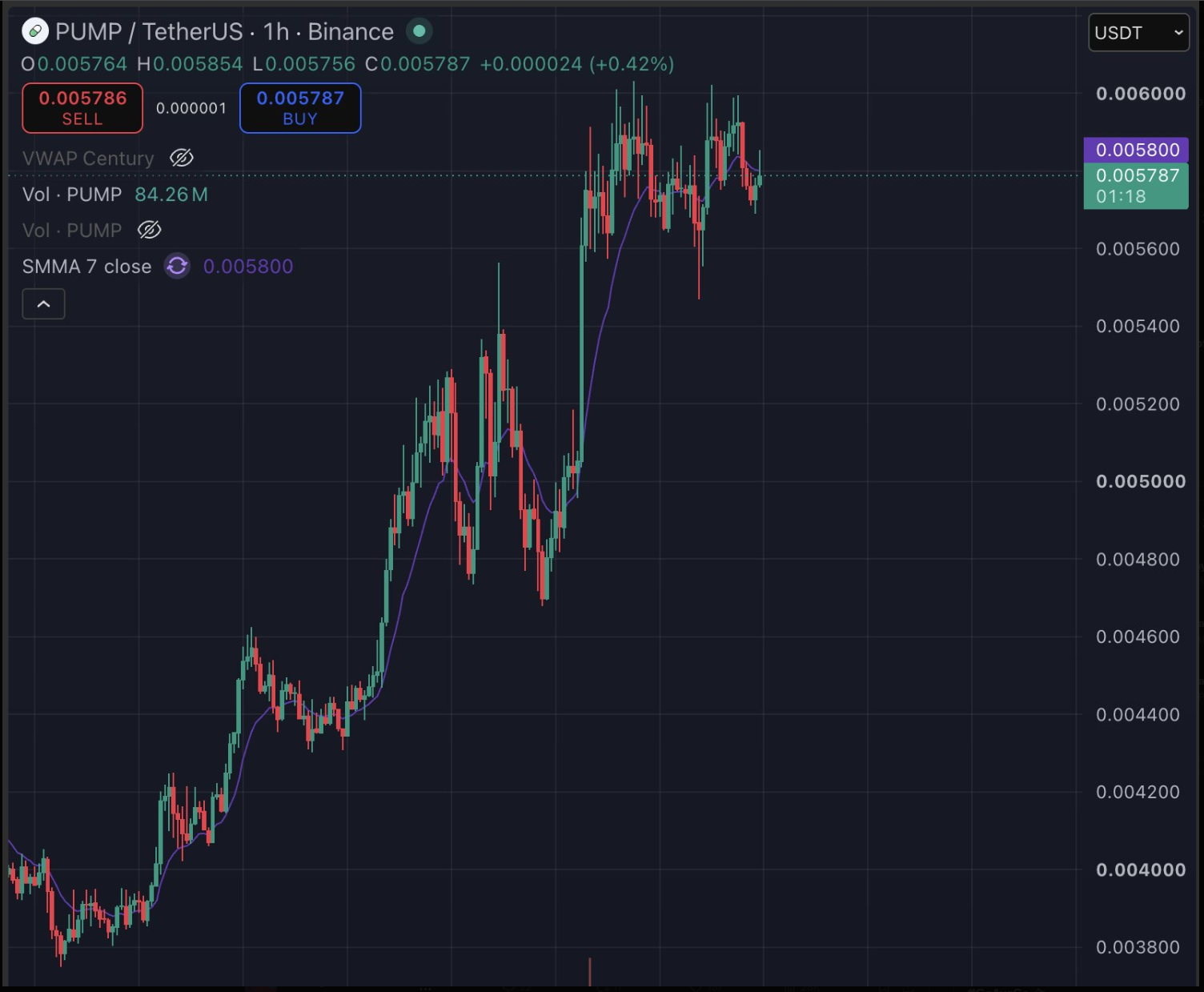
PUMP: my thesis on Pump as a company hasn't changed much since 2025, even as the token price has been volatile. What matters isn't the chart above, strong as it's looked recently: it's the balance sheet and the moat. The Pump Foundation is sitting on close to $2 billion in treasury assets, mostly stablecoins, funded by its 2025 ICO and a platform that has generated over $1.8 billion in lifetime gross revenue. That scale buys optionality most competitors don't have: if someone ships a feature that proves sticky, Pump can have its engineers copy it within weeks rather than compete on being first. The mobile app, with Apple Pay built in, is the clearest expression of that strategy: a direct play to keep users fully inside Pump's ecosystem rather than routing through third party wallets, which only widens the margin advantage over time. I don't see an obvious way a competitor beats that combination of capital and distribution without Pump making a long, unforced series of mistakes.
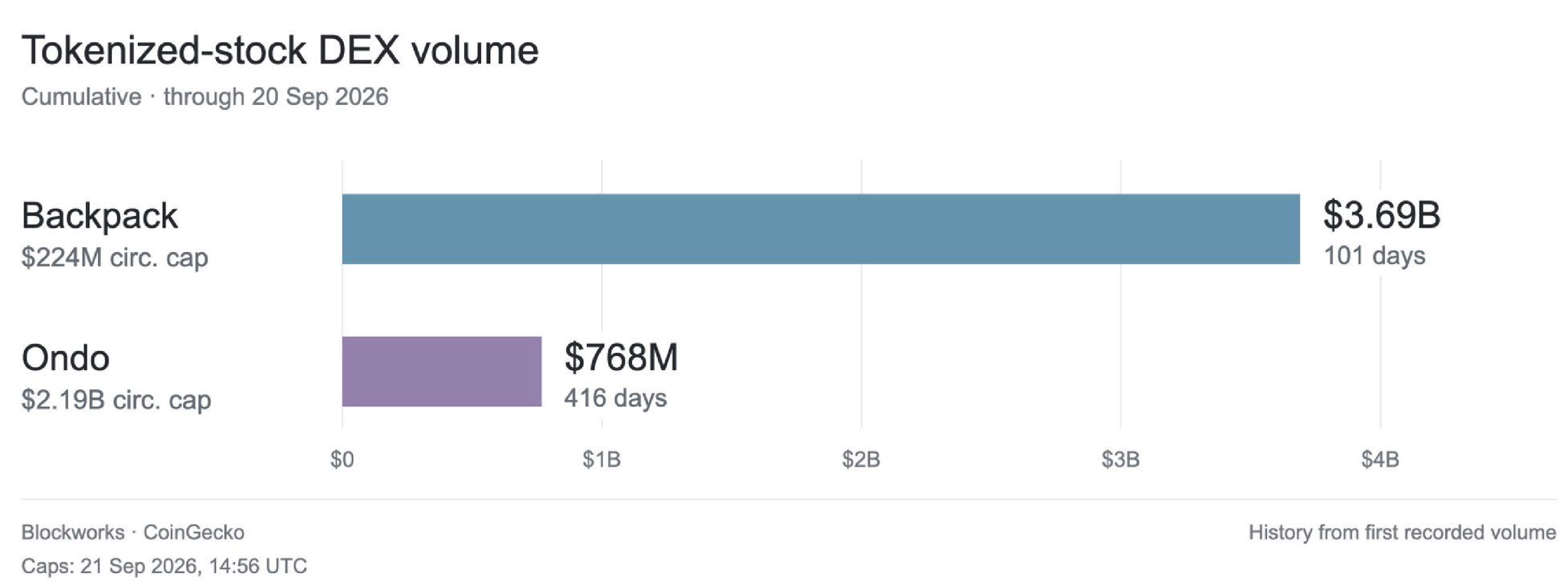
BP: the more interesting data point this quarter is in tokenized equities, not memecoins. Backpack's $BP has done roughly $3.7 billion in cumulative tokenized-stock DEX volume since launching that product, about 4.8x what Ondo has done over a track record nearly four times as long, while BP's circulating market cap sits at roughly 12 percent of Ondo's. Either the market is mispricing Backpack relative to the activity actually happening on it, or Ondo is priced for a dominance it isn't demonstrating in the one metric that should matter most. I don't think that gap closes quietly. Tokenized-stock issuance is turning into a real competitive war between a handful of platforms, and like every other corner of this market, it will follow a power law: the winner captures a disproportionate share of the volume and the value, and the rest become afterthoughts. Backpack's volume lead, this early and against a much smaller market cap, is exactly the kind of signal worth following before it's obvious to everyone else.
How Money Actually Moves
Last quarter I described crypto capital flow as a waterfall: Bitcoin first, then Ethereum, then the broader alt market. I'll expand that into four tiers now, because the opportunity set isn't evenly distributed within “alts” either:
- AThe MarketBitcoin, the most liquid, least differentiated way to express a crypto view, and the asset that absorbs capital first in any recovery.
- BLong Standing MajorsEthereum and Solana. Established enough that allocating here is closer to an index decision than a research decision.
- CNext-Tier CandidatesNames like Hyperliquid, Zcash and Near, where the thesis is that the market eventually re-rates them into Tier B companies.
- DPure Execution BetsNames like Lighter Protocol, Venice, Backpack, and Pump, where the outcome depends almost entirely on whether the team actually ships and wins its specific market, not on broad crypto beta.
Most of the variance in this market lives in Tier D, and so does most of the opportunity. Tiers A and B move with the macro regime described above: they're largely a bet on which door we walk through. Tier D is closer to venture investing inside a liquid wrapper: the macro matters less than whether Pump keeps out-executing competitors on distribution, or whether Backpack's early DEX volume lead compounds into real market share. That's where I'd rather spend research time this quarter, and it's the layer this fund is built to cover that passive crypto exposure can't.
Fund II's own book is built on that same logic, as a barbell rather than an even spread across these four tiers. A 15-25 percent stability allocation in Bitcoin, Ethereum, and Solana, Tiers A and B, anchors the fund without trying to be the source of its return. The remaining 70-90 percent concentrates at two ends: a 35-45 percent Privacy & AI wing (ZEC, XMR, NEAR) and a 35-45 percent Onchain Revenue wing (HYPE, PUMP, VVV), which is broadly where this letter's Tier C and D names, BP and PUMP included, actually sit. A single Bitcoin position only captures one narrative; the barbell is built to hold three at once, with the stability allocation sized to protect the two high conviction wings rather than to drive the return on its own. The one real departure from how Fund I was run: short positions and derivatives come into play opportunistically as a cycle matures, used to manage downside near cyclical peaks rather than to express a constant hedge.
Conclusion
I don't think Q4 is a quarter to lean hard on seasonality alone, however good October's numbers look on a chart. The macro backdrop is more two-sided than it's been in a while (a Fed that just hiked into elevated bond yields on one side, ETF demand and dollar weakness pulling the other way), and Bitcoin's current range is a reflection of that uncertainty, not a reason to force a side before the market picks one. What I am confident in is where I want to be positioned once it resolves: Bitcoin itself if door one wins, the waterfall into Ethereum, Solana, and the names further down the curve if door two does, and a disproportionate share of research time on Tier C and D names like Pump, Backpack, Venice, Lighter and Near regardless of which door we get, because that's where execution outweighs macro.
If you want to talk through any of the names above in more detail, or have any questions regarding this report or an investment into Jones Digital Capital Fund, please contact Carter Jones at 651-724-0685 or carter@jonesdigitalcapital.com.
For informational purposes only. Not an offer to sell or a solicitation of an offer to buy any security. Jones Digital Capital Fund, LLC is not registered as an investment adviser with the SEC or any state regulator. The views expressed are the author's own as of the date of this letter and are subject to change without notice. References to specific protocols, tokens, or price levels are for illustration and are not recommendations to buy or sell any asset; names described as being on our list are not current fund positions. Past performance, including Fund I's results, is not indicative of future results and is not a guarantee of Fund II outcomes. Digital assets are highly volatile and speculative, and an investment in the fund could result in the loss of the entire investment.